There is buying second-hand luxury, and then there is hunting for something everyone else has missed.
For me, that is where the real fun begins.
I have been buying and selling fashion for years, and one thing I have learned about platforms such as Vestiaire Collective is that the best purchase is not necessarily the cheapest item.
The question I ask myself is not:
“Is this cheap?”
It is:
“Has this been incorrectly priced?”
That distinction matters.
And this Bottega Veneta is a perfect example.
The bag had been listed on Vestiaire Collective for just one day at €279. I offered €200. The seller accepted.
At that stage, I knew the bag looked interesting. What I didn’t know was that hidden inside it was a label that would eventually confirm something much more exciting:
this Bottega Veneta was made in 2007.
And judging by the construction, materials and original internal certificate, this is a genuine piece from the Tomas Maier era of Bottega Veneta.
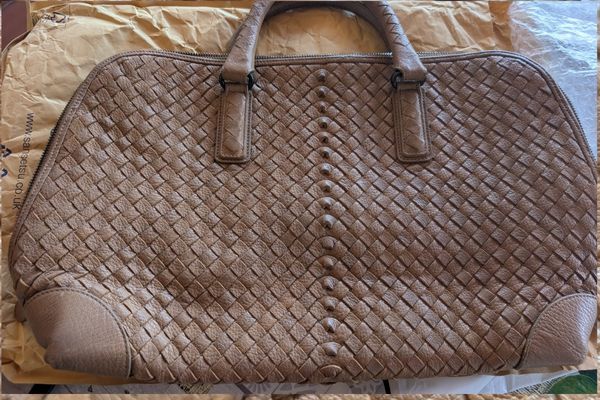
First impressions: old Bottega rather than obvious Bottega
This isn’t the type of handbag that immediately screams its brand across the room.
There is no giant logo.
There is no conspicuous gold plaque.
Instead, there is leather. Lots of it.
The exterior combines Bottega Veneta’s famous Intrecciato woven leather with beautifully textured grained leather, dark metal hardware and elaborate leather detailing around the handles and body.
It is exactly the sort of bag I love finding second-hand because someone scrolling quickly through hundreds of listings could easily overlook it.
A current-season recognisable bag gets instant attention.
A nearly twenty-year-old Bottega requires somebody to stop and actually look at the craftsmanship.
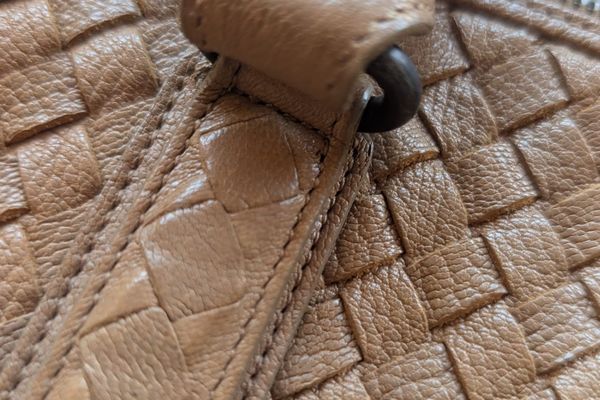
The Intrecciato was my first clue
Bottega Veneta is synonymous with Intrecciato, the house’s famous woven-leather technique.
On this bag, the weaving is not merely decorative embossing pretending to be woven leather.
The strips are individually cut and interlaced. They are consistently sized, but because this is an older bag they have also softened, relaxed and developed movement.
That is important.
Vintage leather shouldn’t necessarily look perfect.
It should look real.
There are wrinkles. There is slight darkening. Some areas have softened more than others. The grain changes around pressure points and where the leather has been handled repeatedly.
Rather than making me suspicious, those imperfections actually made the bag more convincing.
Cheap coated leather tends to age badly.
Good leather develops character.
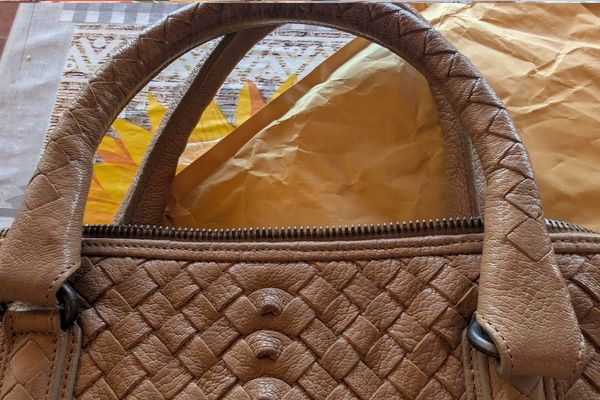
Then I looked at the handles
The handles are one of my favourite details.
They are not simply two basic strips of leather attached to the bag.
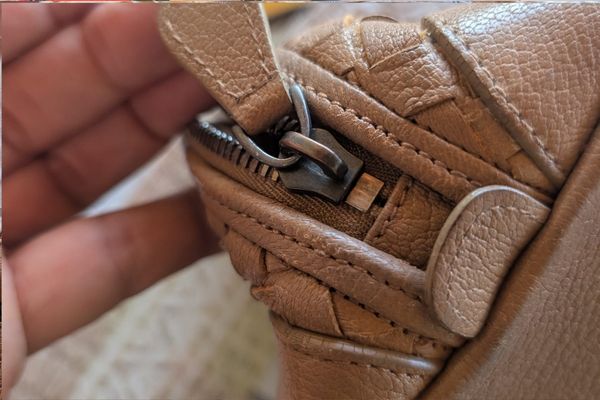
The leather has been wrapped and worked around a structured handle, creating an almost braided or segmented effect. The attachment points are reinforced, and the handles connect through substantial dark metal rings.
These are precisely the details I look for on vintage luxury.
Why?
Because they cost money to make.
When somebody produces a cheap imitation, complicated areas are normally simplified first.
Hidden stitching, internal reinforcement, wrapped handles, properly finished gussets and lined pockets don’t necessarily photograph spectacularly for an online listing.
But they tell you a lot about how a bag was made.
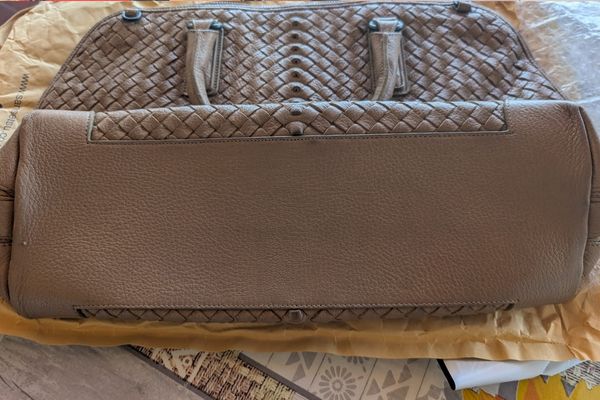
The bottom told another story
Turn the bag over and you find a substantial base constructed from a large piece of heavily grained leather.
The stitching is controlled and even.
The woven leather terminates neatly into the surrounding structure.
There is no obvious cheap shortcut.
The bag has clearly been used, but the underlying construction remains remarkably sound.
That matters far more to me than a few surface marks.
I can live with patina.
I don’t want collapsing construction.
And then there is the suede interior
Opening this bag was another surprise.
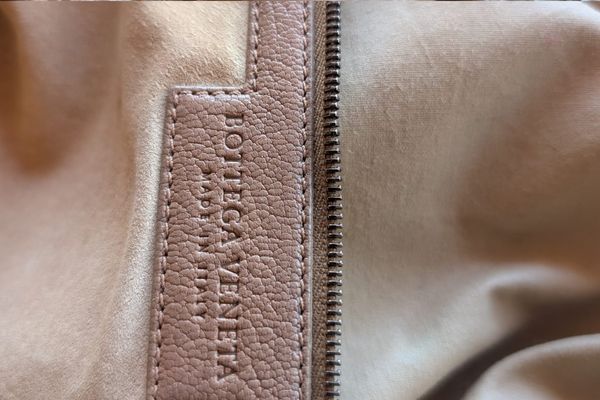
The inside is lined in a soft beige-taupe suede-like material, with a long interior zipped pocket framed in matching leather.
The zip is substantial.
The leather zipper pull matches the rest of the bag.
The pocket construction is neatly finished rather than being treated like an afterthought.
Beside the pocket is the wonderfully discreet blind stamp:
BOTTEGA VENETA
MADE IN ITALY
There is something wonderfully old-school about it.
The branding is there, but it almost disappears into the leather.
This was luxury for people who didn’t need everybody else to know what they were carrying.
But where was the authenticity tag?
Initially, there was one thing bothering me.
I couldn’t find the production label.
Older Bottega Veneta bags used different internal identification systems depending on the period, so not immediately seeing a serial-style label doesn’t automatically mean a bag is fake.
Still, I wanted to find it.
I searched the zipped compartment.
Nothing.
I checked around the suede lining.
Nothing obvious.
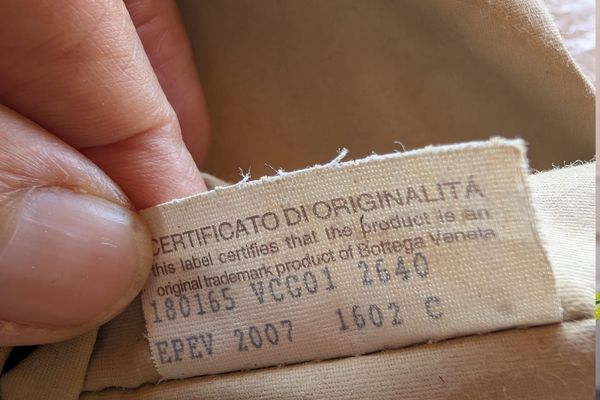
Then, hidden deep inside the bag, there it was.
An old cream fabric label.
Across the top were the words:
CERTIFICATO DI ORIGINALITÀ
Underneath, the English text stated that the label certified the product as an original trademark product of Bottega Veneta.
And below that were the production codes.
The label reads approximately:
186165 VCCO1 7840
EPEV 2007 1602 C
And that little number — 2007 — changed the story.
My €200 bag was made in 2007
So now I don’t have to guess whether this is merely “vintage inspired” or vaguely from the late 2000s.
The bag’s own internal certificate dates it to 2007.
That places it firmly within the period when Tomas Maier was creative director of Bottega Veneta.
Maier joined the house in 2001 and became responsible for one of the most important chapters in modern Bottega history.
Instead of chasing aggressive logos and short-lived trends, Bottega became synonymous with quiet luxury long before the phrase became fashionable on social media.
Exceptional leather.
Italian craftsmanship.
Understated branding.
Beautiful construction.
This bag is almost a textbook example of that philosophy.
Is it definitely a Julie?
Initially I thought the bag might belong to the Bottega Veneta Julie family because several construction details are very similar to documented Julie totes from the same period.
However, I haven’t yet found reliable documentation linking the style number 186165 directly to the Julie name.
So I would rather be accurate.
I can say with confidence that this is a 2007 Bottega Veneta, from the Tomas Maier period.
I wouldn’t currently sell it as a “Julie” unless I could confirm the model number through reliable archival information.
That is something worth remembering when buying vintage.
Don’t force a famous model name onto a bag just because it looks similar.
Sometimes the craftsmanship and provenance are more important than the name anyway.
What kind of leather is it?
The bag combines Intrecciato with a very supple, strongly grained leather.
It has the appearance of the Cervo-style deerskin and other soft pebbled leathers that Bottega used extensively during this period.
The leather has aged beautifully.
It has creased.
It has softened.
The handles have developed patina.
There are areas where the colour and texture have changed subtly over time.
And I wouldn’t try to erase all of that.
This bag is nearly twenty years old.
I don’t want it looking as though somebody covered it in paint yesterday.
I would clean it sympathetically, condition the appropriate areas and perhaps let a professional leather specialist tackle anything more serious.
But vintage should still look vintage.
So was €200 a bargain?
For me, absolutely.
The original asking price was €279.
It had only been listed for a single day when I made my offer.
I paid €200.
That is what makes this purchase particularly interesting.
This wasn’t a bag sitting unwanted on Vestiaire for two years while seller after seller passed it over.
It had barely arrived.
And I spotted it.
At €200, I was buying a beautifully constructed Italian leather handbag.
Then I discovered that it was a genuine 2007 Bottega Veneta with its original internal Certificato di Originalità still attached.
That makes €200 feel very different.
What could it be worth?
Vintage Bottega pricing varies enormously according to model, colour, size, condition and whether the exact bag has suddenly become fashionable again.
I wouldn’t exaggerate the value simply because it is Bottega Veneta.
Mine has been used.
There is visible patina.
The interior isn’t pristine.
The leather shows its age.
But structurally, it is very good.
The weaving is intact.
The handles are sound.
The bottom is strong.
The zippers work.
The interior remains usable.
And most importantly, the bag retains the character that made Tomas Maier-era Bottega so desirable in the first place.
In its current condition, I would see €300–€400 as a realistic quick resale territory.
With careful cleaning, strong photography, professional authentication and the exact model properly researched, I would be comfortable seeing it marketed around €450–€550, depending on the buyer and market.
But I didn’t buy it purely to flip it.
Sometimes the better investment is simply owning something wonderful for very little money.
This is exactly why I still hunt Vestiaire Collective
Anyone can type “Bottega Veneta” into a search bar and sort by highest price.
That isn’t hunting.
The real skill is recognising quality when the listing isn’t perfect.
Look closely at the leather.
Look at the corners.
Look underneath the bag.
Look inside the pockets.
Study the zippers.
Check the lining.
Look at how handles are attached.
And don’t dismiss something simply because it has a few wrinkles.
Sometimes those wrinkles are telling you that you’re looking at twenty years of excellent leather rather than two years of cheap material.
Most importantly, move quickly when something looks genuinely underpriced.
This bag had been online for one day.
The asking price was €279.
My offer was accepted at €200.
Then I went looking for the clues.
The leather looked right.
The Intrecciato looked right.
The construction looked right.
The interior branding looked right.
And finally, hidden inside the bag, I found the original certificate:
Bottega Veneta. Made in Italy. 2007.
That is my kind of vintage shopping.
Not merely finding something cheap.
Finding something valuable before everybody else realises what it is.