How I Found an Authentic 2007 Bottega Veneta On Vestiaire Collective
Listed for one day at €279, bought for €200: how I checked a Bottega Veneta bag on Vestiaire Collective, and the hidden label that dates it to 2007.
There is buying second-hand luxury, and then there is hunting for something everyone else has missed. For me, that is where the fun begins.
I have been buying and selling fashion for years, and on Vestiaire Collective the best buy is not always the cheapest one. The question I ask is not “Is this cheap?” It is “Has this been priced wrongly?”
This Bottega Veneta is the perfect example. It had been listed for one day at €279. I offered €200. The seller accepted. What I didn’t know yet was that there was a label hidden inside it that would tell me the year it was made: 2007.
First impressions: old Bottega, not obvious Bottega
This is not a bag that shouts its name across the room. No giant logo, no gold plaque. Just leather, and a lot of it.
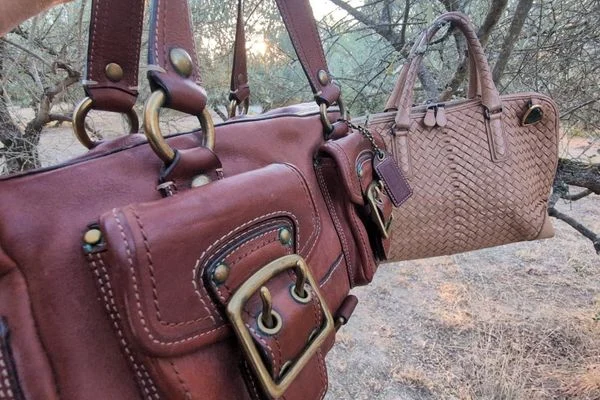
The outside combines Bottega Veneta’s Intrecciato woven leather with a textured grained leather, dark metal hardware and a lot of leather detail around the handles and body. It is exactly the kind of bag I love to find, because someone scrolling through hundreds of listings will go straight past it. A nearly twenty-year-old Bottega needs you to stop and look.
The Intrecciato was my first clue
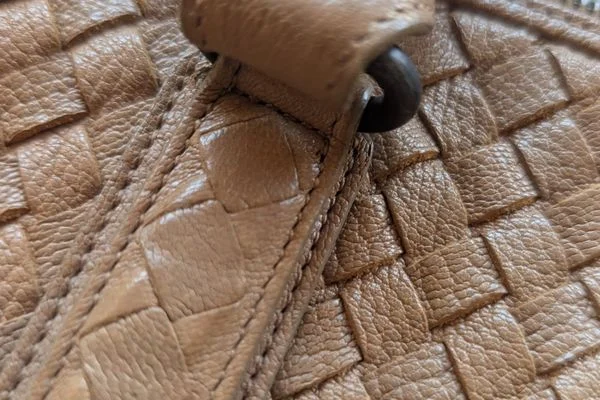
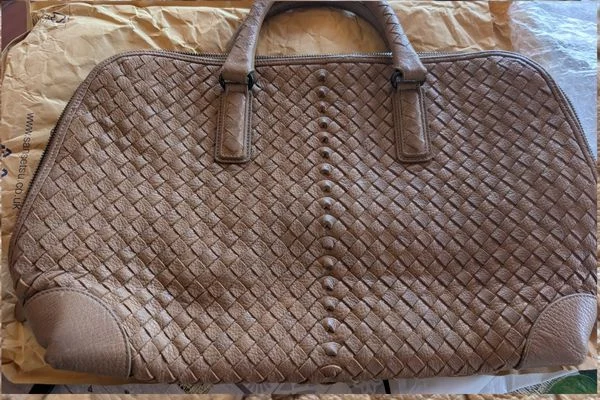
Intrecciato is the house’s woven leather. On this bag it is not a pattern pressed into the surface to look woven. The strips are cut one by one and interlaced. They are the same width, and because the bag is old they have softened and started to move.
Vintage leather shouldn’t look perfect. It should look real. There are wrinkles, a little darkening, and the grain changes where hands have held it again and again. That didn’t make me suspicious. It made me more sure. Cheap coated leather ages badly. Good leather gets better.
Then I looked at the handles
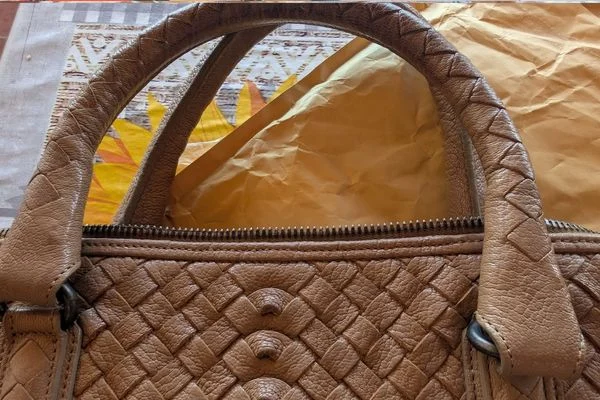
The handles are my favourite part. They are not two strips of leather stitched on. The leather is wrapped and worked around a core, so it looks almost braided, and the handles join the bag through heavy dark metal rings with the joins reinforced.
These are the details I look for, for one reason: they cost money to make. When somebody makes a cheap copy, the complicated parts are the first to be simplified. Hidden stitching, wrapped handles, finished gussets and lined pockets don’t look like much in a listing photo. They tell you how a bag was made.
The bottom told another story
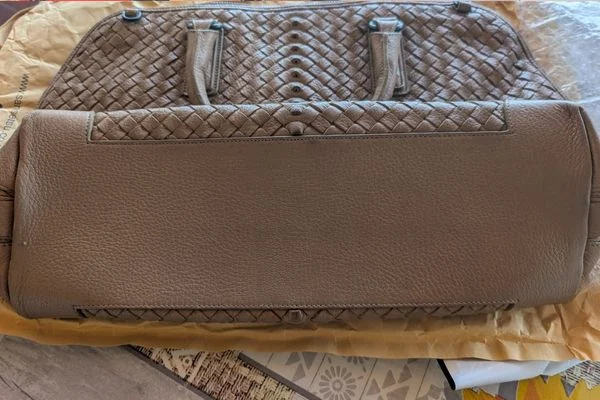
Turn the bag over and the base is one large piece of heavily grained leather. The stitching is even. The weave ends neatly where it meets the base. The bag has been used, but the construction is sound, and that matters far more to me than a few marks. I can live with patina. I don’t want a bag that is falling apart.
And then the suede inside
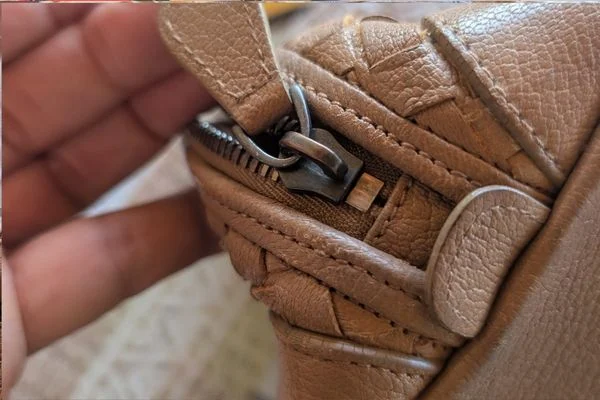
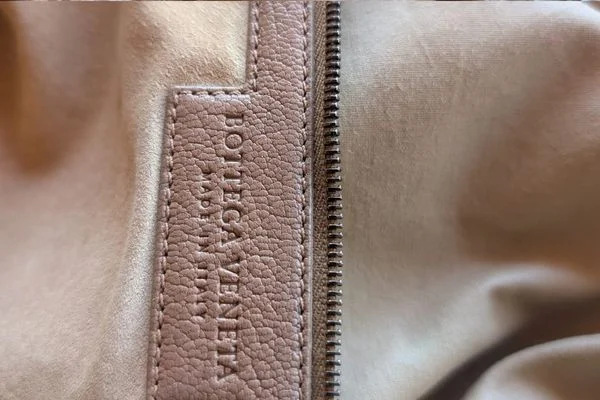
The inside is lined in a soft taupe suede, with a long zipped pocket framed in matching leather. The zip is heavy and its leather pull matches the bag. Beside the pocket is a blind stamp: BOTTEGA VENETA, MADE IN ITALY. It almost disappears into the leather. This was made for people who didn’t need everybody to know what they were carrying.
But where was the authenticity tag?
One thing bothered me. I couldn’t find the production label. Older Bottega Veneta bags were labelled in different ways at different times, so not seeing one doesn’t make a bag fake. I still wanted to find it.
I searched the zipped pocket and the lining and found nothing. Then, deep inside the bag, there it was: an old cream fabric label headed CERTIFICATO DI ORIGINALITÀ, with English text certifying the bag as an original Bottega Veneta product, and the production codes underneath. The batch number is 160165. The colour code is 2640, one of the house’s beige-to-walnut earth tones. And then the year.
That little number, 2007, changed the story.
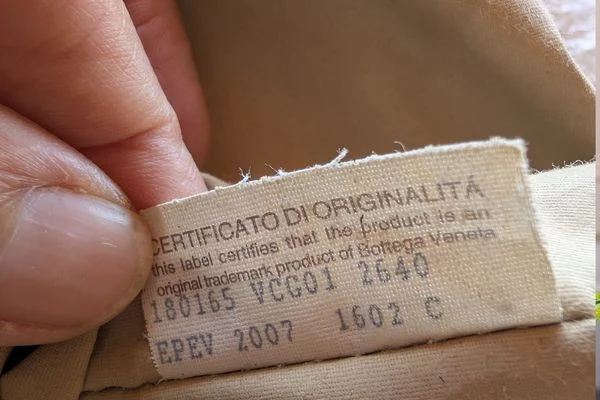
My €200 bag was made in 2007
So I don’t have to guess. The bag’s own certificate dates it to 2007, when Tomas Maier was creative director. He joined the house in 2001, and under him Bottega stood for leather, Italian craftsmanship and almost no branding. This bag is all three.
Is it definitely a Julie?
At first I thought it might be from the Julie family, because several details are close to Julie totes of the same years. But I haven’t found anything reliable that ties this bag to that name, so I won’t call it one. I can say it is a 2007 Bottega Veneta from the Tomas Maier years.
Remember that when you buy vintage. Don’t force a famous name onto a bag because it looks similar.
What kind of leather is it?
The bag pairs the Intrecciato with a very supple, strongly grained leather: lambskin or calfskin, soft in the way Bottega’s leathers of those years are.
It has creased and softened, and the handles have their patina. I wouldn’t try to erase that. It is nearly twenty years old, and I don’t want it looking as though somebody painted it yesterday. I will clean it gently, condition it, and leave anything serious to a leather specialist.
So was €200 a bargain?
For me, absolutely. It was asking €279 and had been up for a single day. It wasn’t a bag that had sat unwanted for two years. It had only just arrived, and I spotted it. When I looked at what Bottega bags had sold for, I couldn’t find one in this price range. I was ecstatic when the seller accepted my offer.
What could it be worth?
Vintage Bottega prices go up and down with the model, the colour, the size and the condition, and I wouldn’t exaggerate. Mine has been used. The patina shows and the inside isn’t pristine. But the weave is intact, the handles and base are strong, and the zips work.
As it is, I would see €300 to €400 as a realistic price for a quick resale. Cleaned, well photographed, professionally authenticated and with the model properly researched, €450 to €550. But I didn’t buy it to flip it. Sometimes the better investment is owning something wonderful for very little money.
Why I still hunt on Vestiaire Collective
Anyone can type “Bottega Veneta” into a search bar and sort by the highest price. That isn’t hunting. The skill is seeing quality when the listing isn’t perfect.
- Look closely at the leather, and at the corners.
- Look underneath the bag, and inside the pockets.
- Study the zips and the lining.
- Look at how the handles are attached.
- Don’t dismiss a bag for a few wrinkles. They can mean twenty years of good leather, not two years of cheap material.
- Move quickly when something is underpriced.
That is my kind of vintage shopping. Finding something valuable before everybody else realises what it is.