Vintage Coach Bag – And It May Be Worth Hundreds
I paid €60 for a 2006 Coach Legacy leather satchel. What the creed number told me, why it may be worth hundreds, and what to do about pen marks.
There is nothing I enjoy more than finding a luxury bag that everyone else has overlooked.
Where is the fun in walking into a boutique and paying full retail? For me it has always been about the hunt: vintage stores, online resale platforms, antique markets, and those slightly forgotten listings where the seller perhaps doesn’t realise what they have.
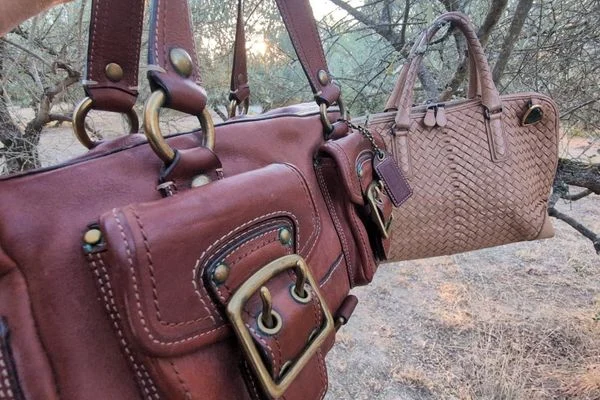
This time I paid €60 for a vintage Coach leather satchel, in Arezzo. At first I simply loved the bag. Thick cognac leather, enormous antique-brass buckles, and that slightly battered look a bag only gets from being used. Then I started investigating, and my €60 purchase became a lot more interesting.
The Coach bag that stopped me in my tracks
This is not the neat, polished Coach you might know from today’s shopping malls. It is big. It is heavy. And it is all leather.
It has that mid-2000s attitude, when a handbag was supposed to look expensive because there was so much material and hardware in it. There are huge buckles on the front, chunky brass rings holding the handles, pockets, straps and contrast stitching. The colour is somewhere between cognac, whisky and warm chestnut.
The leather has the kind of patina I love. Some people see signs of use. I see personality. Vintage leather shouldn’t look as though it left the factory yesterday.
The serial number told me everything
Inside the bag is the Coach leather creed. The number on it reads J0669-10330. That little number tells us quite a lot.
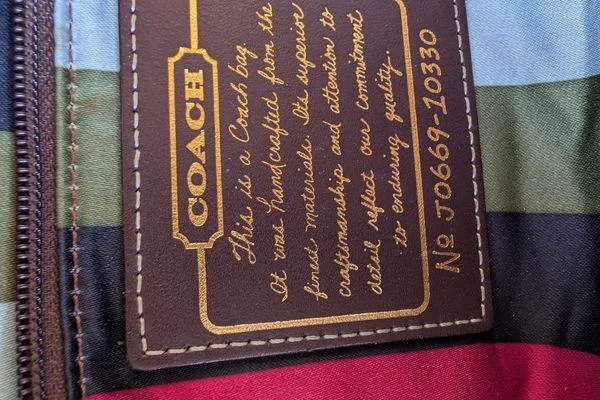
The bag dates from 2006, around Coach’s 65th anniversary, and style number 10330 belongs to the Coach Legacy collection.
You know the quality the moment you handle one. The hardware has weight. The leather is thick. The stitching is even. It makes me ask whether a modern luxury bag costing ten times more is ten times better. My answer? Often, no.
Then I opened the bag
This might be my favourite part. Inside is the striped Coach Legacy lining: pink, red, green, cream and chocolate. You don’t expect it against that serious brown leather. Open the zip and there is all this colour.
This is what I love about vintage. Designers put details inside a handbag that only the owner would ever see. The lining was part of the design. Mine is still beautiful, and the bag is around two decades old. There is one problem.
Someone left pen marks inside it
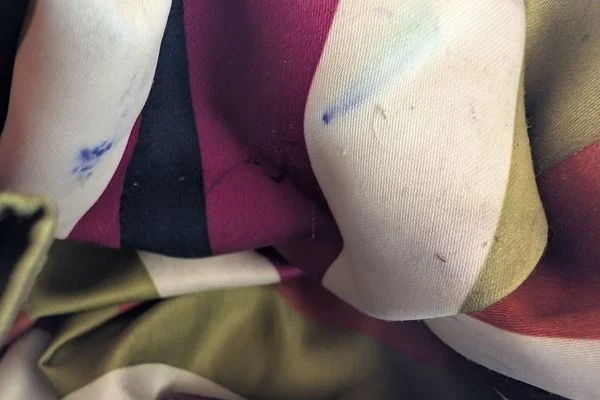
With vintage there is always something. The previous owner let a pen mark the lining, and going by the age of the bag the ink has probably been there for years. Would I rather it wasn’t there? Of course. Does it ruin the bag? No.
This is where people go wrong with vintage pieces. They are so set on making something look new that they destroy what made it valuable.
How old pen ink comes out of a fabric lining
Old ink can sometimes be reduced a great deal, but you need patience. My rule is simple: do less than you think you need to do. I would never pour a cleaning product straight onto vintage fabric, never soak a lining, and never go near it with bleach, acetone or nail-polish remover.
On an ordinary fabric lining, the usual method is a tiny amount of 70% isopropyl alcohol.
- Test a place nobody will see first.
- Put a clean white cloth under the stained part of the lining.
- Barely dampen a cotton bud with the alcohol. Dab. Do not rub. The idea is that the ink moves from the fabric onto the cotton bud and the cloth underneath.
- Change cotton buds often.
- Stop, let the fabric dry completely, and look again.
Vintage restoration is not a race. Three very gentle goes over several days are safer than one aggressive one. And keep the alcohol away from the leather, because it can take the colour and the finish off very quickly.
If 90 per cent of a pen mark went and a faint shadow stayed, I would leave it. A twenty-year-old handbag is allowed to have a history.
Why €60 was such a good buy
Similar Coach Legacy bags now change hands for several hundred euros when they are authentic, complete and in good condition. Depending on the colour, the condition and where they are sold, asking prices climb higher. Would I say my €60 bag is worth €700? No.
There is a big difference between an optimistic asking price and what somebody actually pays. But I would comfortably call this a several-hundred-euro vintage Coach, because the leather, the hardware, the creed and the Legacy lining are all there. That makes €60 rather delicious.
Don’t only ask, “Is this cheap?”
Ask, “Has this been mispriced?” A cheap unwanted handbag may stay a cheap unwanted handbag. A desirable vintage bag wrongly listed at €60 is something else entirely.
Why vintage Coach is interesting again
Fashion has a habit of going back to what it rejected. For years handbags got smaller, cleaner and more minimal. Now the interest is back in large leather bags, oversized buckles, distressed finishes, archive shapes and early-2000s accessories. So those chunky old Coach bags make sense again. And this one was built properly.
Mine feels as though I could fill it with laptops, cameras, magazines, cosmetics and half of Tuscany, and it would survive. That is luxury I understand.
How do you remove old pen ink from a silk lining?
This is where I stopped myself from doing what the internet recommends. The striped lining in my bag is silk, and silk changes everything. Alcohol, strong stain removers and even too much water can damage vintage silk, make the colours bleed or leave permanent rings.
The ink has been there for years. Keeping the original lining matters more to me than getting rid of every trace of a stain. So I am not going to experiment on it. I would have the ink looked at by a professional cleaner or a handbag restorer who knows silk.
An update. It is all good now: fixed and shiny.
Sometimes the most important part of restoring vintage is knowing when to stop. A little ink is part of the bag’s history. A ruined silk lining is permanent.