There are antique markets, and then there is Arezzo.
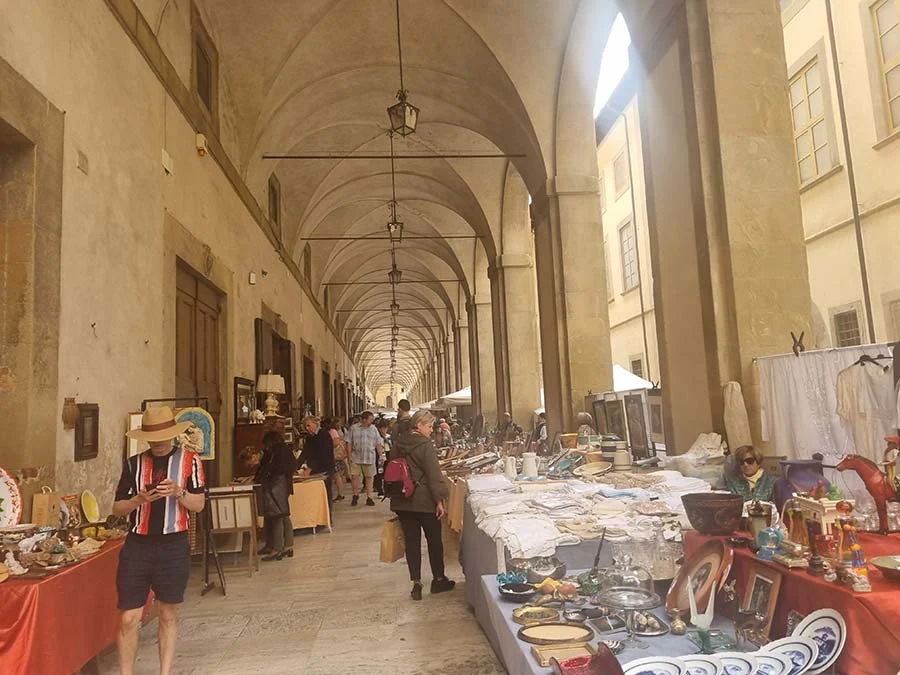
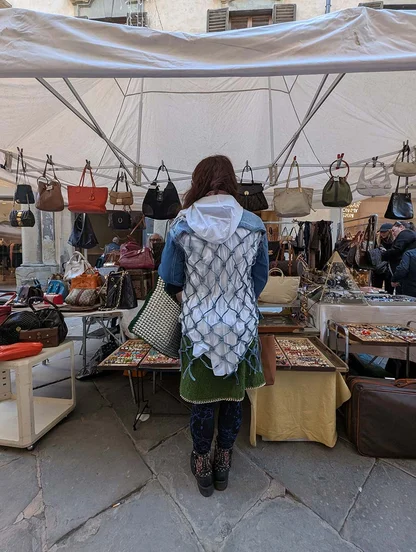
Once a month, the historic centre of this beautiful Tuscan city turns into an enormous treasure hunt. Furniture appears beneath medieval arches, paintings lean against ancient stone walls, tables overflow with jewellery and silver, and boxes filled with objects from somebody else’s life wait to be explored.
The Fiera Antiquaria di Arezzo has been running since 1968 and is regarded as Italy’s oldest and largest regularly held open-air antiques fair. It takes place on the first Sunday of every month and the Saturday immediately before, spreading through Piazza Grande, the Logge Vasari, Piazza San Francesco and the surrounding streets. More than 500 exhibitors can take part, selling everything from paintings and porcelain to watches, textiles, books, furniture and wonderfully strange collectibles.
But with hundreds of dealers and thousands of objects, how do you actually find the good pieces?
After spending plenty of time hunting vintage and antiques in Italy, my first piece of advice is simple: stop shopping like a tourist and start looking like a hunter.
Arezzo Antique Market: How to Find the Best Vintage Treasures in Tuscany
There are antique markets, and then there is Arezzo.
Once a month, the historic centre of this beautiful Tuscan city turns into an enormous treasure hunt. Furniture appears beneath medieval arches, paintings lean against ancient stone walls, tables overflow with jewellery and silver, and boxes filled with objects from somebody else’s life wait to be explored.
The Fiera Antiquaria di Arezzo has been running since 1968 and is regarded as Italy’s oldest and largest regularly held open-air antiques fair. It takes place on the first Sunday of every month and the Saturday immediately before, spreading through Piazza Grande, the Logge Vasari, Piazza San Francesco and the surrounding streets. More than 500 exhibitors can take part, selling everything from paintings and porcelain to watches, textiles, books, furniture and wonderfully strange collectibles.
But with hundreds of dealers and thousands of objects, how do you actually find the good pieces?
After spending plenty of time hunting vintage and antiques in Italy, my first piece of advice is simple: stop shopping like a tourist and start looking like a hunter.
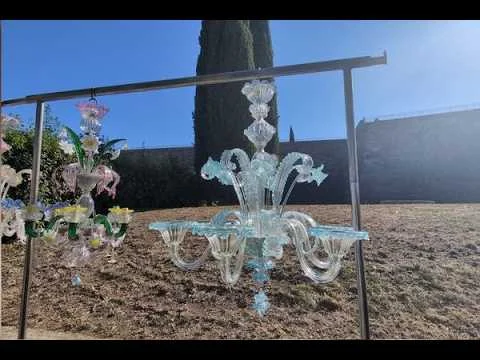
1. Don’t Only Look at the Beautiful Stalls
The perfectly styled stall in Piazza Grande may photograph beautifully, but it isn’t necessarily where you will find your bargain.
Professional dealers know how to present their best pieces. The spectacular mirror positioned at eye level has probably already been researched, valued and priced accordingly.
I am much more interested in what is underneath the table.
Look at the boxes on the floor. Look behind the furniture. Look at the pieces still wrapped in newspaper. Look inside baskets and drawers.
Some of my favourite vintage discoveries have been objects that didn’t look particularly exciting until I picked them up.
At an antique market, curiosity saves money.
2. Arrive Early – But Understand Why
Serious collectors arrive early because they want first choice.
At Arezzo, the hunt can effectively begin while dealers are setting up. The fair itself even describes buyers searching for pieces while merchandise is still being unloaded before continuing their negotiations until Sunday evening.
If you’re looking for something specific – a designer bag, particular ceramics, antique jewellery or an important piece of furniture – Saturday morning is the time to be there.
But there is another strategy.
Come towards the end of Sunday.
A dealer who has been standing there all weekend may be considerably more interested in negotiating than they were at 9am on Saturday.
Especially if your purchase means one less heavy object to load back into the van.
3. Learn to Touch Things
Vintage shopping online has trained us to look at photographs.
Antique markets require something different.
Pick things up.
Weight often tells you something about quality.
Feel the leather. Turn ceramics over. Open the handbag. Look underneath the chair. Examine the back of the painting. Check how a drawer has been constructed.
You begin to recognise quality through your hands.
A beautifully aged piece of Italian leather, for example, can feel completely different from inexpensive coated material. Likewise, old solid brass has a weight that many modern decorative reproductions simply don’t have.
This doesn’t automatically prove age or authenticity, but it tells you to investigate further.
4. Don’t Be Frightened by Dirt
One of the greatest mistakes vintage shoppers make is confusing dirty with damaged.
They are not the same thing.
Dust can be removed. Brass can be polished. Leather can often be conditioned. Wood can sometimes be waxed. Silver tarnishes. Old fabric may simply need careful cleaning.
A slightly neglected object may actually be your opportunity because other shoppers can’t visualise how it could look.
Damage is different.
Cracked ceramics, severe woodworm, broken structural joints, badly split leather and extensive restoration can dramatically change what an item is worth.
You need to learn the difference between patina and destruction.
Sometimes 30 minutes of careful cleaning can transform something.
Sometimes no amount of restoration will make the purchase worthwhile.
5. Look for Italian Craftsmanship, Not Just Famous Names
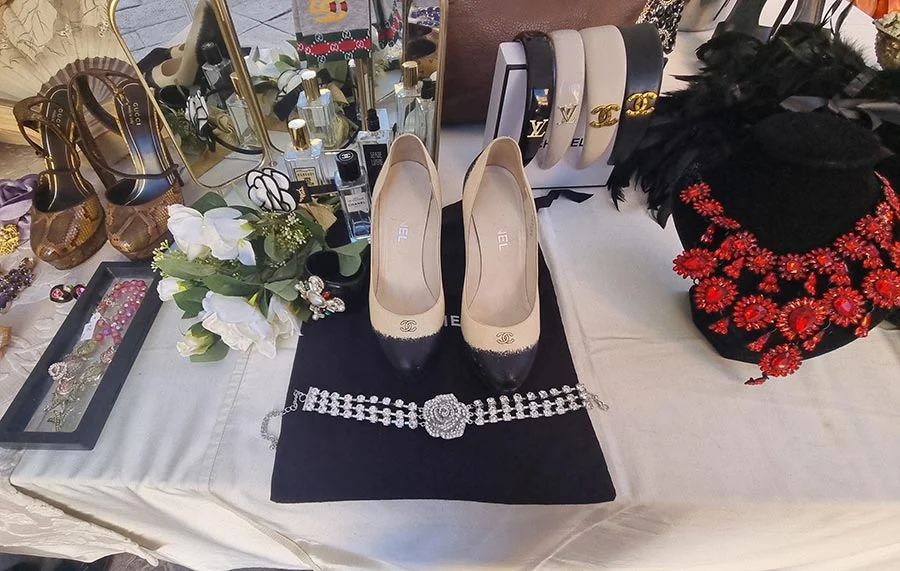
Everyone recognises Gucci, Prada and Bottega Veneta.
That recognition usually comes with a price.
What I find far more interesting in Italian markets are the beautifully made pieces carrying a name you’ve never heard of.
Italy has generations of leather workers, ceramicists, silversmiths, furniture makers and textile producers whose craftsmanship can be superb without having a global luxury logo attached.
Turn objects over and start looking for clues:
Made in Italy. Firenze. Toscana. Murano. Deruta. Bassano. Handmade markings. Workshop stamps. Silver hallmarks. Old labels. Manufacturer’s plaques.
Research can come later.
At the market, you’re training your eye.
6. Never Assume Old Means Valuable
Arezzo contains treasures.
It also contains lots of ordinary old things.
That distinction matters.
Something can be 80 years old and still have very little monetary value.
Meanwhile, an unusual piece from the 1970s or 1980s may be extremely desirable today.
Age alone isn’t enough.
Think about craftsmanship, condition, scarcity, design, provenance and whether people actually want to own it.
Most importantly, ask yourself:
Would I still want this if nobody told me it was valuable?
If the answer is yes, you’re already making a better purchase.
7. Antique Markets Are About Relationships
Don’t immediately begin every conversation by trying to reduce the price.
Talk to the dealer.
Ask where the object came from.
Ask its age.
Ask what they know about the maker.
Ask whether they have similar pieces.
Italian antique dealers often know considerably more about their stock than the small handwritten label suggests.
And once you begin talking, another wonderful thing can happen.
They show you the pieces you hadn’t seen.
There may be another handbag under the table.
Another painting inside the van.
Another ring in a case.
The market you see isn’t necessarily all the stock that is available.

8. Negotiate – But Don’t Insult the Seller
Yes, you can negotiate at Arezzo.
No, that doesn’t mean offering €20 for something marked €100.
If I like a piece, I prefer asking:
“Qual è il miglior prezzo?” – What’s your best price?
Let the seller move first.
If an object is €120 and they immediately say €100, you now know there is room.
You can decide whether €90 is a reasonable counteroffer.
Buying several objects from the same dealer can also give you much more negotiating power.
And remember that a bargain isn’t defined by how much money you knocked off.
Paying €70 for something worth €300 is a bargain.
Paying €30 for something you never wanted is €30 wasted.
9. Carry Cash
Italy has moved increasingly towards card payments, but an antique market is one place where I still prefer having cash.
It makes small purchases easier and can simplify negotiations.
But don’t wave around hundreds of euros while trying to explain that €10 is absolutely your maximum budget.
Have smaller notes available.
10. Photograph Before You Walk Away
This is one of my most important tips.
You see something you love.
You decide to “have a little think.”
Twenty minutes later you want it.
Now where was it?
Arezzo’s market spreads through streets, squares and arcades throughout the historic centre. It is surprisingly easy to lose a particular dealer.
Take a photograph of the item and another photograph showing the stall or nearby landmark.
Better still, ask the dealer for a business card.
There is nothing worse than spending an hour trying to locate “the man with the amazing green lamp.”
11. Measure Before Buying Furniture
A huge Tuscan sideboard looks magnificent standing beneath the Logge Vasari.
Then you get it home and discover it doesn’t fit through the doorway.
If you’re seriously shopping for your home, keep measurements on your phone.
Door widths.
Ceiling height.
Available wall space.
Boot dimensions.
And carry a small tape measure.
It may be the least glamorous accessory you take to an antique market, but possibly the most valuable.
12. Your Best Find May Be Something You Never Intended to Buy
This is why I love Arezzo.
Going with a list is sensible.
Going with blinkers isn’t.
You might arrive looking for a mirror and leave carrying a ceramic leopard.
You might find a 1970s Italian lamp you didn’t know existed.
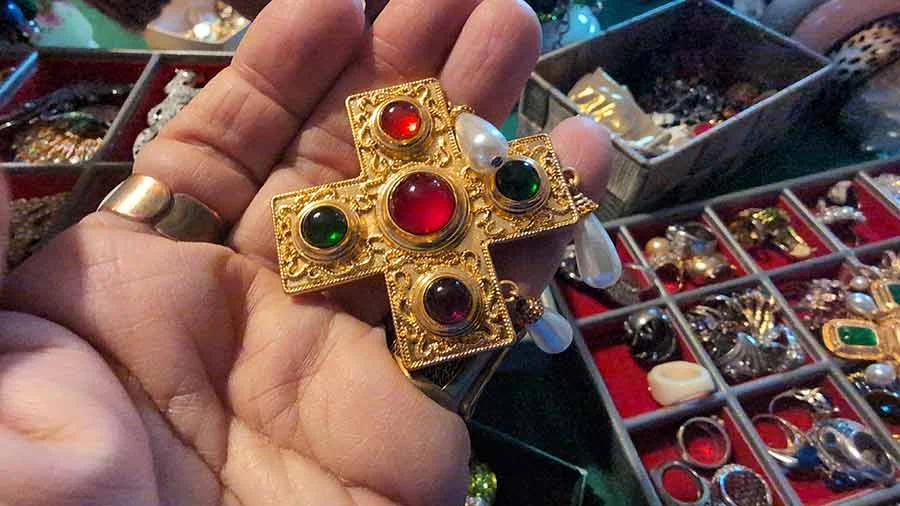
An extraordinary vintage handbag.
A painting.
A silver bracelet.
A ridiculous chair that suddenly becomes the entire personality of a room.
The joy of a genuine antique market is discovery.
Online shopping gives us exactly what we search for.
Markets give us what we never knew we wanted.
The Real Secret to Shopping Arezzo
Don’t rush.
The official fair describes Arezzo as a meeting point for antiques, modern antiques and vintage objects, but the location is half the experience. Piazza Grande, the Vasari Loggia and Arezzo’s medieval streets effectively become the backdrop to the market. (Fiera Antiquaria di Arezzo)
Have a coffee.
Walk one section.
Stop for lunch.
Go back.
Look again.
Objects you ignored at 9am can suddenly become interesting at 3pm.
And don’t become obsessed with proving that you’ve found the bargain of the century.
The best vintage purchase is often simply something beautifully made that gives you enormous pleasure and that you could never have found in a modern department store.
That is why I keep returning to antique markets.
You aren’t simply buying an object.
You’re buying something that has already lived a life – and taking it home to begin another.
Visiting the Arezzo Antique Market
The Fiera Antiquaria is normally held in Arezzo’s historic centre on the first Sunday of each month and the preceding Saturday. For 2026, the remaining scheduled editions after September are 3–4 October, 31 October–1 November and 5–6 December. Check the official fair information before travelling, particularly when planning a trip around a specific weekend. (Discover Arezzo)
Gracie Opulanza
Vintage hunter, luxury lover and firm believer that the most interesting things in life are rarely found in the new-arrivals section.
1. Don’t Only Look at the Beautiful Stalls
The perfectly styled stall in Piazza Grande may photograph beautifully, but it isn’t necessarily where you will find your bargain.
Professional dealers know how to present their best pieces. The spectacular mirror positioned at eye level has probably already been researched, valued and priced accordingly.
I am much more interested in what is underneath the table.
Look at the boxes on the floor. Look behind the furniture. Look at the pieces still wrapped in newspaper. Look inside baskets and drawers.
Some of my favourite vintage discoveries have been objects that didn’t look particularly exciting until I picked them up.
At an antique market, curiosity saves money.
2. Arrive Early – But Understand Why
Serious collectors arrive early because they want first choice.
At Arezzo, the hunt can effectively begin while dealers are setting up. The fair itself even describes buyers searching for pieces while merchandise is still being unloaded before continuing their negotiations until Sunday evening. (Discover Arezzo)
If you’re looking for something specific – a designer bag, particular ceramics, antique jewellery or an important piece of furniture – Saturday morning is the time to be there.
But there is another strategy.
Come towards the end of Sunday.
A dealer who has been standing there all weekend may be considerably more interested in negotiating than they were at 9am on Saturday.
Especially if your purchase means one less heavy object to load back into the van.
3. Learn to Touch Things
Vintage shopping online has trained us to look at photographs.
Antique markets require something different.
Pick things up.
Weight often tells you something about quality.
Feel the leather. Turn ceramics over. Open the handbag. Look underneath the chair. Examine the back of the painting. Check how a drawer has been constructed.
You begin to recognise quality through your hands.
A beautifully aged piece of Italian leather, for example, can feel completely different from inexpensive coated material. Likewise, old solid brass has a weight that many modern decorative reproductions simply don’t have.
This doesn’t automatically prove age or authenticity, but it tells you to investigate further.
4. Don’t Be Frightened by Dirt
One of the greatest mistakes vintage shoppers make is confusing dirty with damaged.
They are not the same thing.
Dust can be removed. Brass can be polished. Leather can often be conditioned. Wood can sometimes be waxed. Silver tarnishes. Old fabric may simply need careful cleaning.
A slightly neglected object may actually be your opportunity because other shoppers can’t visualise how it could look.
Damage is different.
Cracked ceramics, severe woodworm, broken structural joints, badly split leather and extensive restoration can dramatically change what an item is worth.
You need to learn the difference between patina and destruction.
Sometimes 30 minutes of careful cleaning can transform something.
Sometimes no amount of restoration will make the purchase worthwhile.
5. Look for Italian Craftsmanship, Not Just Famous Names
Everyone recognises Gucci, Prada and Bottega Veneta.
That recognition usually comes with a price.
What I find far more interesting in Italian markets are the beautifully made pieces carrying a name you’ve never heard of.
Italy has generations of leather workers, ceramicists, silversmiths, furniture makers and textile producers whose craftsmanship can be superb without having a global luxury logo attached.
Turn objects over and start looking for clues:
Made in Italy. Firenze. Toscana. Murano. Deruta. Bassano. Handmade markings. Workshop stamps. Silver hallmarks. Old labels. Manufacturer’s plaques.
Research can come later.
At the market, you’re training your eye.
6. Never Assume Old Means Valuable
Arezzo contains treasures.
It also contains lots of ordinary old things.
That distinction matters.
Something can be 80 years old and still have very little monetary value.
Meanwhile, an unusual piece from the 1970s or 1980s may be extremely desirable today.
Age alone isn’t enough.
Think about craftsmanship, condition, scarcity, design, provenance and whether people actually want to own it.
Most importantly, ask yourself:
Would I still want this if nobody told me it was valuable?
If the answer is yes, you’re already making a better purchase.
7. Antique Markets Are About Relationships
Don’t immediately begin every conversation by trying to reduce the price.
Talk to the dealer.
Ask where the object came from.
Ask its age.
Ask what they know about the maker.
Ask whether they have similar pieces.
Italian antique dealers often know considerably more about their stock than the small handwritten label suggests.
And once you begin talking, another wonderful thing can happen.
They show you the pieces you hadn’t seen.
There may be another handbag under the table.
Another painting inside the van.
Another ring in a case.
The market you see isn’t necessarily all the stock that is available.
8. Negotiate – But Don’t Insult the Seller
Yes, you can negotiate at Arezzo.
No, that doesn’t mean offering €20 for something marked €100.
If I like a piece, I prefer asking:
“Qual è il miglior prezzo?” – What’s your best price?
Let the seller move first.
If an object is €120 and they immediately say €100, you now know there is room.
You can decide whether €90 is a reasonable counteroffer.
Buying several objects from the same dealer can also give you much more negotiating power.
And remember that a bargain isn’t defined by how much money you knocked off.
Paying €70 for something worth €300 is a bargain.
Paying €30 for something you never wanted is €30 wasted.
9. Carry Cash
Italy has moved increasingly towards card payments, but an antique market is one place where I still prefer having cash.
It makes small purchases easier and can simplify negotiations.
But don’t wave around hundreds of euros while trying to explain that €10 is absolutely your maximum budget.
Have smaller notes available.
10. Photograph Before You Walk Away
This is one of my most important tips.
You see something you love.
You decide to “have a little think.”
Twenty minutes later you want it.
Now where was it?
Arezzo’s market spreads through streets, squares and arcades throughout the historic centre. It is surprisingly easy to lose a particular dealer.
Take a photograph of the item and another photograph showing the stall or nearby landmark.
Better still, ask the dealer for a business card.
There is nothing worse than spending an hour trying to locate “the man with the amazing green lamp.”
11. Measure Before Buying Furniture
A huge Tuscan sideboard looks magnificent standing beneath the Logge Vasari.
Then you get it home and discover it doesn’t fit through the doorway.
If you’re seriously shopping for your home, keep measurements on your phone.
Door widths.
Ceiling height.
Available wall space.
Boot dimensions.
And carry a small tape measure.
It may be the least glamorous accessory you take to an antique market, but possibly the most valuable.
12. Your Best Find May Be Something You Never Intended to Buy
This is why I love Arezzo.
Going with a list is sensible.
Going with blinkers isn’t.
You might arrive looking for a mirror and leave carrying a ceramic leopard.
You might find a 1970s Italian lamp you didn’t know existed.
An extraordinary vintage handbag.
A painting.
A silver bracelet.
A ridiculous chair that suddenly becomes the entire personality of a room.
The joy of a genuine antique market is discovery.
Online shopping gives us exactly what we search for.
Markets give us what we never knew we wanted.
The Real Secret to Shopping Arezzo
Don’t rush.
The official fair describes Arezzo as a meeting point for antiques, modern antiques and vintage objects, but the location is half the experience. Piazza Grande, the Vasari Loggia and Arezzo’s medieval streets effectively become the backdrop to the market. (Fiera Antiquaria di Arezzo)
Have a coffee.
Walk one section.
Stop for lunch.
Go back.
Look again.
Objects you ignored at 9am can suddenly become interesting at 3pm.
And don’t become obsessed with proving that you’ve found the bargain of the century.
The best vintage purchase is often simply something beautifully made that gives you enormous pleasure and that you could never have found in a modern department store.
That is why I keep returning to antique markets.
You aren’t simply buying an object.
You’re buying something that has already lived a life – and taking it home to begin another.
Visiting the Arezzo Antique Market
The Fiera Antiquaria is normally held in Arezzo’s historic centre on the first Sunday of each month and the preceding Saturday. For 2026, the remaining scheduled editions after September are 3–4 October, 31 October–1 November and 5–6 December. Check the official fair information before travelling, particularly when planning a trip around a specific weekend. (Discover Arezzo)
Gracie Opulanza
Vintage hunter, luxury lover and firm believer that the most interesting things in life are rarely found in the new-arrivals section.