Swimwear Through a Vintage Lens
A history of women’s swimwear, from Roman mosaics and Victorian bathing machines to the 1946 bikini, Lycra and the red Baywatch swimsuit.

It is summer, and most women’s plans include a trip to the beach at some point. With the beach comes the question of what to wear in the water. Covered up and comfortable, or free and a little exposed? Women have wrestled with that one for a very long time.
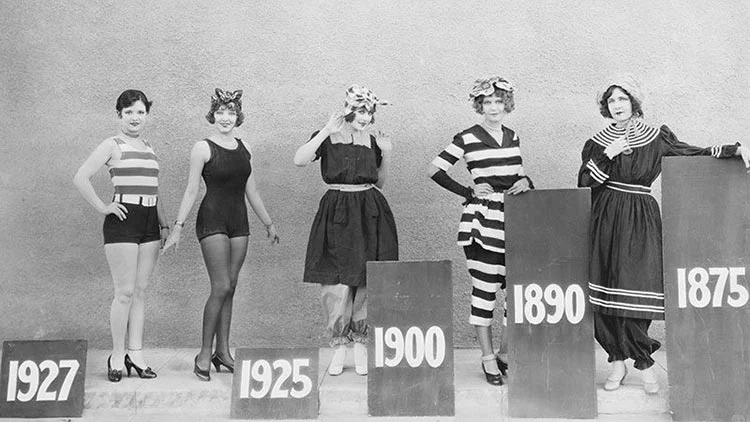
Beach pyjamas also came out in the 1930s.
Bathhouses
In the beginning, women had little choice but to bathe au naturel. Clothing was heavy, or made of material that did not suit water. In ancient times bathing was just that: bathing, to get clean. It was done at bathhouses, in rooms separated by gender, or privately at an outdoor water source. Many women bathed nude, or in a small top much like the bandeau of our day with simple loose-fitting bottoms. Ceramic tile pictures of this swimwear have survived, and they give us a vague idea of what was thought proper for women of the time. This lasted until the Middle Ages, when public bathing seems to have stopped altogether.

The Roman ‘bikini girls’
The mosaic known as the ‘ancient bikini girls’ was found when archaeologists excavated the Roman villa near Piazza Armerina in Sicily. It may have been made in the 4th century CE by North African artists, since some of the tesserae, the pieces of the mosaic, come from Africa.

The Victorian era
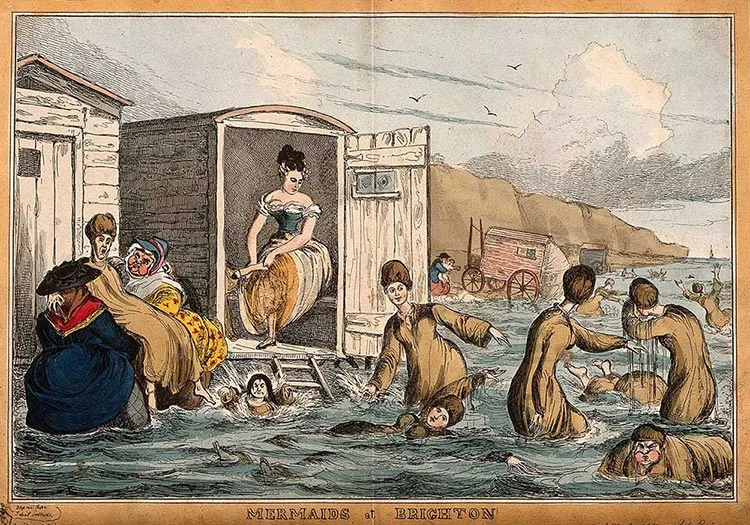
Public sea bathing did not become popular again until the Victorian era, although some spas opened in France and England in the 17th and 18th centuries that promoted bathing for health, sometimes in mixed company. To say that women approached public swimming with caution is an understatement. Propriety came first, even before being able to swim. Bathing machines, wagons that let a woman bathe inside four walls, were used to hide her from the public eye. And it probably was not safe to go under in the swimwear of the 1700s and 1800s, with its corsets and its many petticoats.
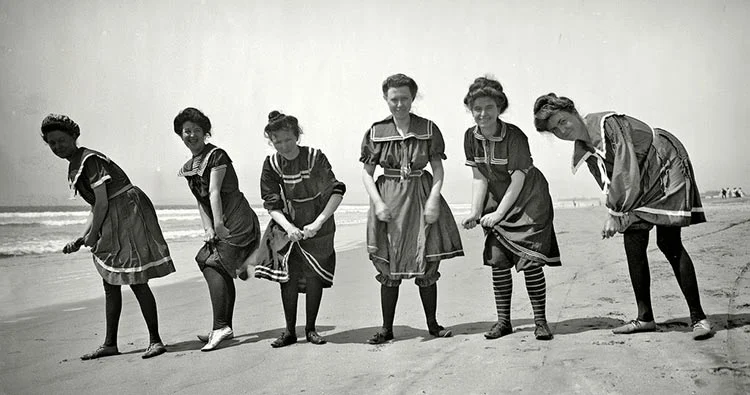
Anyone who has worn vintage clothing knows the weight of all those layers of fabric. Some women even sewed weights into their hems to stop their skirts floating up and showing their legs. Now imagine that fabric soaked with gallons of water. It is easy to see how drowning was a real danger.
The main difference between beach clothing and street clothing seems to have been the length of the skirt, which came to about the knee. But women still wore bloomers, stockings and shoes underneath, so one wonders what advantage these beach looks gave at all. By 1855 some beachwear was a shorter-sleeved day dress with an apron, bloomers and black stockings, which allowed a bit more freedom.
Mermaids at Brighton by William Walker
Things finally began to change between 1900 and 1920, for a number of reasons. The largest in Western culture was the First World War, which changed social roles that had been set for hundreds of years. Women found themselves with more freedom in general, through the move towards women’s suffrage and through their work at home and for the war.
By 1910 it was no longer a criminal offence for a woman to bare her legs and arms in public. Swimming was also growing as a sport and as a school lesson. So swimsuits became more practical, though they were still made of wool. Most were sleeveless and tailored, and fell to about mid-thigh. Because they were fitted, women could at last swim and move freely in the water. In 1915 the Jantzen company of Portland, Oregon, coined the term “swimsuit”, to go with its “red diving girl” logo and its line of wool swimwear.


The 1940s two-piece bathing suit
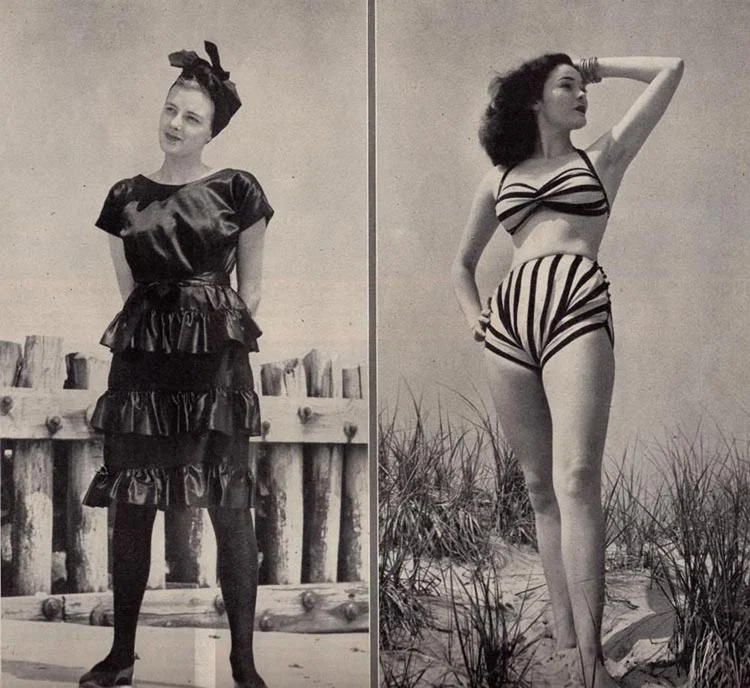
In the 1930s we begin to see a swimsuit that looks like the modern one-piece.
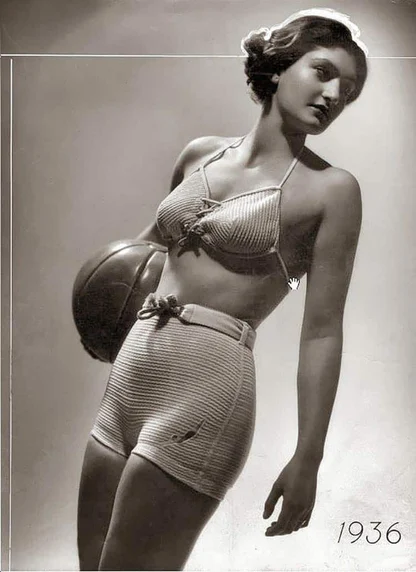
Swimsuits hugged the curves and left arms and legs fully bare. They were made of fabrics better suited to swimming, such as latex. The bottom half was more like a very short skirt than the briefs we see now. The early 1940s brought the two-piece bathing suit. It was always high-waisted and always covered the navel, since it was still thought indecent to bare the lower abdomen.
1946 saw the true bikini, invented by Louis Réard, which did bare the navel. It was thought so scandalous that models would not wear it on the runway in Paris. The first woman to model it was an exotic dancer, Micheline Bernardini. That same summer, women began to try it on the beaches of Cannes. Over the next decades the bikini went from a shameful display to ordinary pool and beachwear across Western culture.

The 1950s
In the 1950s the fashionable body was curves, curves and more curves. But swimsuit fabrics had no structure to support them. So corset companies moved into bathing wear, and made suits with light boning through the middle that flattened the tummy and lifted the bust to the beauty standard of the day.
By the 1960s women wanted to be free of all that structure. Young women especially were ready for the bikini. More private pools at home let them get used to wearing less in a comfortable setting. Bikinis of this time still covered the chest and the lower half fully, and showed the navel. In 1965 textile companies developed a new fabric called Lycra, or spandex. Most of us now have quite a few things in our wardrobes made with it.

Spandex let a swimsuit fit like a glove and dry quickly, which made it right for serious swimming.
A 1960 swimsuit advertisement
From the 1970s through the 1990s leg lines rose, midriffs grew and straps thinned. That led to the string bikini, the strapless suit and even the thong, and left women asking what was left of the outfit. Some modern styles do beg the question: why not just go nude?


The ladies of Baywatch, around 1990
That is the real question for women now, as we look to the past to decide what we wear. When it comes to swimwear we have gone from practically naked to completely clothed and back again.

All the while, swimsuits have nearly always stood for sexuality, which makes things more complicated still for women who swim in public. Is modern swimwear celebratory, harmless, practical or exploitative? Some women enjoy celebrating their bodies by baring it all. Others are more comfortable in something modest. Every woman wants the suit that leaves her feeling attractive, comfortable and ready for a day of activity. And women are now free to choose for themselves what is beautiful and practical, without the social penalties their foremothers faced. Self-determination and choice are the spice of life, especially when it comes to beach attire.